EEAT is especially important for Lawyers and YMYL topics. This case study has convinced me that EEAT matters more than backlinks.
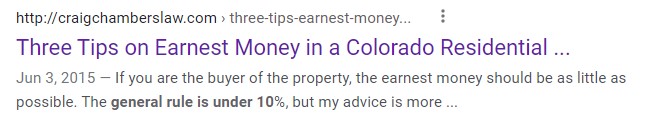
How vital is EEAT for YMYL topics? For a specific legal topic, my dad's law websiteranks higher than Rocket Mortgage, which has a DR of 79. My dad's website has a DR of 0.1, which would suggest that EEAT is more important than backlinks.
For context, when I wrote this post, my Dad's website had 240 backlinks, while Rocket Mortgage had 6.4 million backlinks.
Table of Contents
Does EEAT matter?
My dad's website is old, and it is not SEO optimized. The indexed webpage is not even secure.
So how was my Dad's site able to outrank a website with 6.4 million links?
A given author's experience and expertise are relevant to all queries. However, EEAT is more heavily enforced for YMYL topics, such as legal topics.
EEAT originated from the Google Rater Guidelines. EEAT is used to identify high-quality content through offsite and onsite factors related to the credibility of a given entity. There is no single EEAT factor. It's a combination of offsite and onsite factors and a combination of algorithms.
Is EEAT A Ranking Factor?
Google's engineers use feedback from the Google Rater Guidelines to guide how they adjust the algorithm.
Google notes that it uses specifically two informetric scoring systems, the Needs Met Rating and Page Quality Rating, to determine a given page's rank. The Page Quality Rating includes EEAT, and depending on your topic, a given Page Quality Rating can have an outsized effect on YMYL topics.
A given page is given a Page Quality Rating from 1-5; if the entity, website, and or author are qualified experts in the topic of the webpage, then the page can have a score as high as 5; if the entity is not a qualified expert in the topic, it can have a Page Quality Rating as low as 1, regardless of the number of backlinks.
I've put together a chart with some examples for someone writing about Flu research, a hot topic. This chart helps determine where a given page's EEAT might fall based on an author or site's credentials and experience. Note that it has nothing to do with backlinks.
Expert Experience
Inexperienced
Qualified
Qualified-Expert Right Job Title, Right Degree (MD, Virologist)
Qualified non-expert Right Degree, Wrong Job Title (MD, Physician)
Unqualified
Unqualified-Expert Wrong Degree, Right Job Title (Biologist, Virology Researcher)
A page with lower quality content can outrank a page with higher quality content as long as the author of that lower quality content is a qualified expert.
Another way to look at it is if you have two web pages with exactly the same content on them, say they both have a 5/5 Needs Met Rating, then the page with the higher Page Quality Rating will outrank.
In the following table, Webpage B would rank higher than Webpage A, even though it has a slightly worse Needs Met Rating.
Needs Met Rating
Page Quality Rating
Total Rating
Page A
5
1
6
Page B
4
5
9
EEAT is not a numeric ranking factor that we can easily measure. Instead, it's a subjective assessment of a given entity's expertise, authority, and trustworthiness on a given topic. The Google Rater Guidelines attempts to quantify expertise into an objective number(1-5), based on thousands of survey opinions because algorithms cannot make qualitative assessments.
Note that an engineer's job would be to quantify expertise numerically. There are only so many ways to quantify expertise consistently.
Like all types of expertise, there is a hierarchy; for some subjects, that hierarchy is impossible to fake. Notably, professionals in the YMYL industries, such as Legal services, are required to have certifications on publicly listed websites. Thus, adding JD to your name does not make you an expert, and while you might trick users, Google can tell.
Schools list graduating classes online. Handymen are often required to list their certifications on a per county publicly accessible database. Your HVAC person is probably only certified in a select number of counties, and it's easy to confirm it.
It is straightforward for a bot or user to verify whether a given author is a legitimate expert in the subject beyond the usage of bylines.
That is the point; EEAT should be easy to verify and hard to fake for both users and bots. Thus, to demonstrate your EEAT, you should prioritize displaying each author's credentials in their bylines. As well as ensuring your authors have the necessary expertise to write about the topic.
How Does A Website Demonstrate EEAT?
Similarly, websites can join organizations that add trust and authority, and reviews are only the start.
Direct listing for authors and website entities will help to a varying degree. Usually, legitimate websites and organizations have relationships with other legitimate organizations; once again, it's not about backlink DA.
What Is YMYL?
YMYL stands for "Your Money or Your Life." Google uses it to differentiate a website's content related to topics important to people's safety, health, or financial well-being.
Google uses YMYL to help understand how a website's content relates to topics important to people's safety, health, or financial well-being. So, for example, a site that sells clothing would likely not be considered YMYL, while most webpages that offer health or medical advice would be regarded as YMYL.
(Search Quality Rater Guidelines, 2022, p. 11)
How EEAT Helps You Outrank
My dad is a Real Estate Broker and a Lawyer. Few people are more qualified to share their opinion on Real Estate Law. Content written by a qualified expert in any subject should inherently have a ranking advantage. That doesn't mean that the content is formatted well or that the site is fast.
My dad's website is in spot number 2, for a specific query.
Search results
Rocket Mortgage had a DR of 79; it was in the top 10 before some updates. Now it's 36.
Search results
The State of Colorado was ranked number 6 with a DR of 90.
Entities without authorship are an interesting SEO beast. Conceptually, it’s opinions that require authorship.
Search results
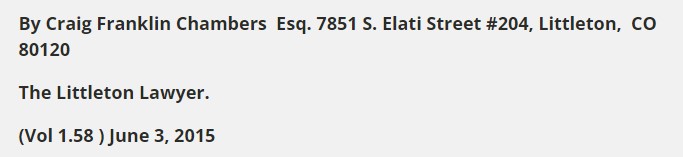
Now I'll show you the authors for each page. You can then tell me, purely based on authorship, which content has more Authority, Expertise, and Trustworthiness. If we were to Google the authors, we could further verify their authority on this subject - which is what raters are asked to do to vet authority.
How Did EEAT Hurt The Rocket Mortgage Post?
While the content on the Rocket Mortgage website is not objectively harmful, it is unclear from the on-page visuals whether the author of Rocket Mortgage is a qualified expert in real estate or qualified to give legal advice at all.
Assuming the content has a 100% Needs Met Score and is the best content ever written, it would still only have 50% of what's needed to rank on the first page.
To get a perfect Page Quality Score, the entity responsible for the content would have to be a certified expert in Real Estate Law.
Reading the author's bio content does not help demonstrate expertise. The author likes gardening.
As a user, I’m unsure whether his hobbies qualify him to provide financial advice. I’d like to see some titles in his name, maybe degrees, professional certifications, or at the minimum, a job title that suggests that he’s worked in the field and knows a thing or two about the subject.
In cases like Rocket Mortgage, I wonder if removing the author from the page would help since Rocket Mortgage, the entity, is probably qualified to give Mortgage advice.
There is a common misconception that sites need an author to demonstrate authority. Sometimes an author can do the opposite.
The Government Site Was Authorless
The State of Colorado, while authorless, is heavily regulated and trustworthy; it's evident that this site is a government entity from the about sections and the logo.
Who is more of an expert on a state's laws than the government that created those laws?
How Did EEAT Help The Law Firms Post?
Now my dad’s site goes a bit overboard with the EEAT; we are 100% certain that this person is an expert in the subject, and specifically within the State of Colorado.
The topic is hyper-specific to Colorado law. My dad wrote a post about the specific requirements of this legal subject in Colorado, so the content has a high Needs Met Score.
Additionally, my dad is a qualified expert in this specific subject, which gives the page a high Page Quality Score.
As a result of EEAT, my dad's website can outrank some very high DR websites. Despite the fact that his site has other issues.
How Law Firms Can Use EEAT To Outperform
My dad is not using tricks to manipulate search; he's a genuine expert demonstrating his expertise on his blog. He doesn't know anything about the web.
When I wrote this, the specific page Google indexed didn't even have a security lock, yet it still outranks Rocket Mortgage and the Colorado Government's webpages.
My dad loves to write, as many lawyers do. About 15 years ago, someone told him that all he needed to do was include some location-specific words in his blog posts.
Over a few years, he wrote about a hundred blogs. Now, he spends very little on advertising, gets most of his clients from his website, and has many paying clients at any time.
I remember suggesting to him to write blogs on obscure legal subjects and include numbers in the titles.
Since then, I have worked as a professional SEO who has built sites that generate their income solely from organic searches. Feel free to contact me if you need help with your SEO strategy.
I can tell you that expert authors are the next big thing in SEO. Now, I know what you're thinking - that sounds expensive. However, did you know that most academics write for a living? You may be paying more for a random SEO without the qualifications, such as a JD, to write content that is unlikely to ever rank.
I am not suggesting that you need a doctorate to write authoritative content - but it helps.
How Much Do Backlinks Help A Post Rank?
Backlinks are important, but they only matter up to a point. It's possible for a website with fewer backlinks and less ranking power to outrank a website with exponentially more backlinks.
The concept of "link juice" is a term invented by SEOs out of necessity.
PageRank, in all forms, is applied to pages and not to domains. So, when SEOs talk about Domain Authority, they are incorrect from the outset because it is a flawed approach to measure PageRank at the domain level.
Plus, former Google employees had confirmed that the original PageRank was replaced in 2006 when the PageRank patent expired.
In any regard, 6.4 million links are a lot of links.
We surmise that links don't matter nearly as much as they used to.
Conclusion: Does EEAT Matter For SEO?
Backlink strategies focus on gaining PageRank, a numerical measurement of authority. Getting caught up in backlinks is excellent for SEO companies. SEOs might think that backlinks are the reason content isn't ranking. We rarely want to admit that maybe the content is the reason.
The Google Rater Guidelines provide excellent examples of websites with expertise, authority, and trustworthiness, so I encourage you to read them.
Please consider the Google Rater Guidelines as a user survey verifying that Google is showing users the right SERPs.
When we look at the concepts that tie search engine informetric systems together, they usually combine multiple scores to produce relevant content.
If you had told me a couple of years ago that I could type "a cyberpunk hedgehog making a latte" and get a photorealistic 4K video back in seconds, I would have laughed. But here we are in 2026, and AI video generation isn't just a novelty anymore, it's a massive part of my daily workflow.
This guide leverages my experience to break down how to write, structure, and publish a document that earns trust rather than just demanding attention.
Depending on who you ask, there are anywhere from five to twenty "essential" rules out there. But in my experience, there are really only a dozen “laws” of visual design that matter across every medium. Here’s a guide I’ve created with the elements I find to be the most important, no matter your platform.
I love WordPress for its customizations. Styling code snippets enhances user perceptions. Copy and paste the code below to style your WordPress code blocks.
If you had told me a couple of years ago that I could type "a cyberpunk hedgehog making a latte" and get a photorealistic 4K video back in seconds, I would have laughed. But here we are in 2026, and AI video generation isn't just a novelty anymore, it's a massive part of my daily workflow.
This guide leverages my experience to break down how to write, structure, and publish a document that earns trust rather than just demanding attention.
Depending on who you ask, there are anywhere from five to twenty "essential" rules out there. But in my experience, there are really only a dozen “laws” of visual design that matter across every medium. Here’s a guide I’ve created with the elements I find to be the most important, no matter your platform.
I love WordPress for its customizations. Styling code snippets enhances user perceptions. Copy and paste the code below to style your WordPress code blocks.