Learn how we reduced Google Ads cost per acquisition by 59% through campaign restructuring, SKAGs, and improved Quality Score, without increasing ad spend.
After managing Google Ads accounts for years, certain patterns become unavoidable. You learn what consistently works, what quietly wastes money, and where performance hides even inside “successful” accounts.
What follows is not a theory. It is a repeatable approach that works even when an account is already hitting its KPIs.
At first glance, the account looked healthy. Cost per acquisition was within target. Conversion volume was steady. No obvious issues surfaced in standard reports.
Most teams would have stopped there.
We didn’t.
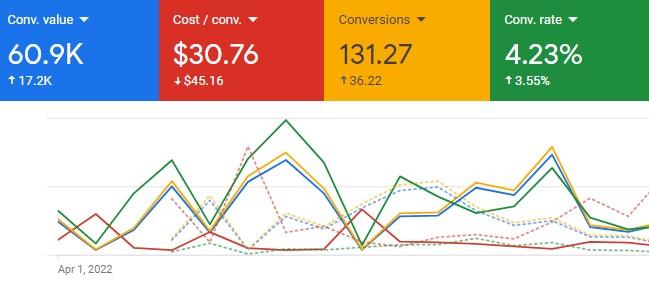
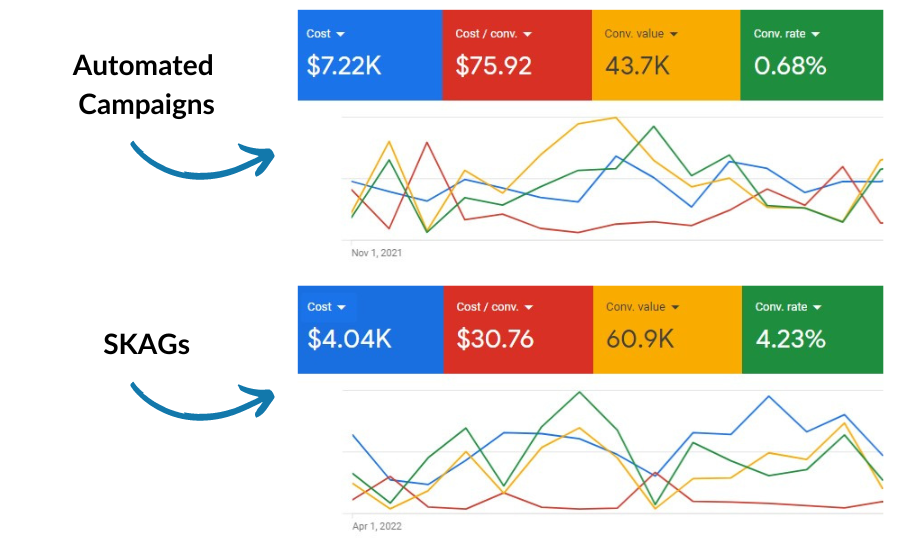
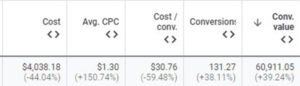
After restructuring the account and moving away from fully automated campaigns, we reduced cost per conversion by 59% and increased conversion value by 39%, without increasing spend.
SKAG Campaigns - Every Metric Improved
What Changed: From Automation to Precision
The Hidden Problem
When we reviewed historical data, a clear pattern emerged.
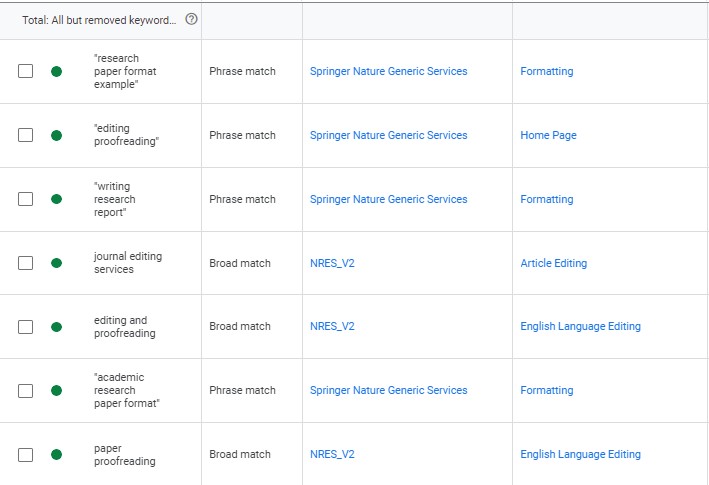
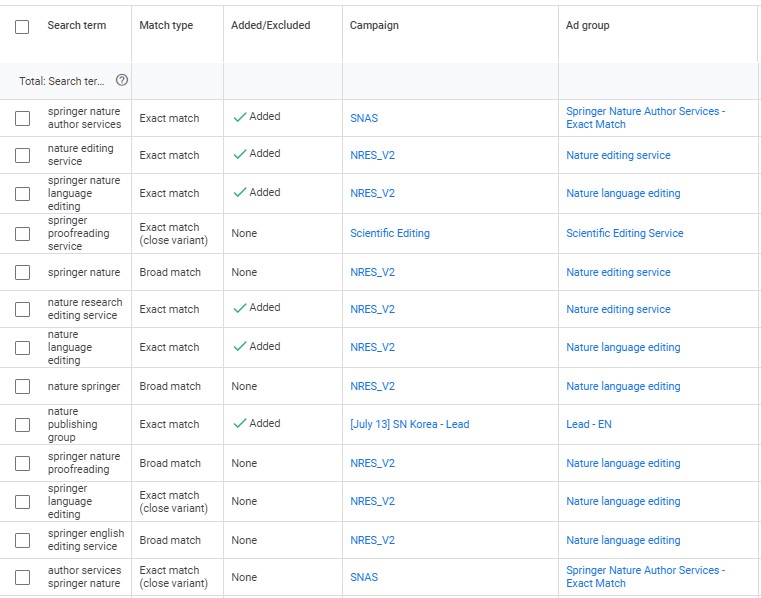
Most conversions did not come from broad, generic keywords like “paper proofreading”. They came from specific long-tail search terms, such as “Nature editing”.
In other words, the account was optimized for reach, but revenue was driven by precision.
Despite this, the majority of spend was allocated to automated campaigns bidding on broad-match, non-branded terms.
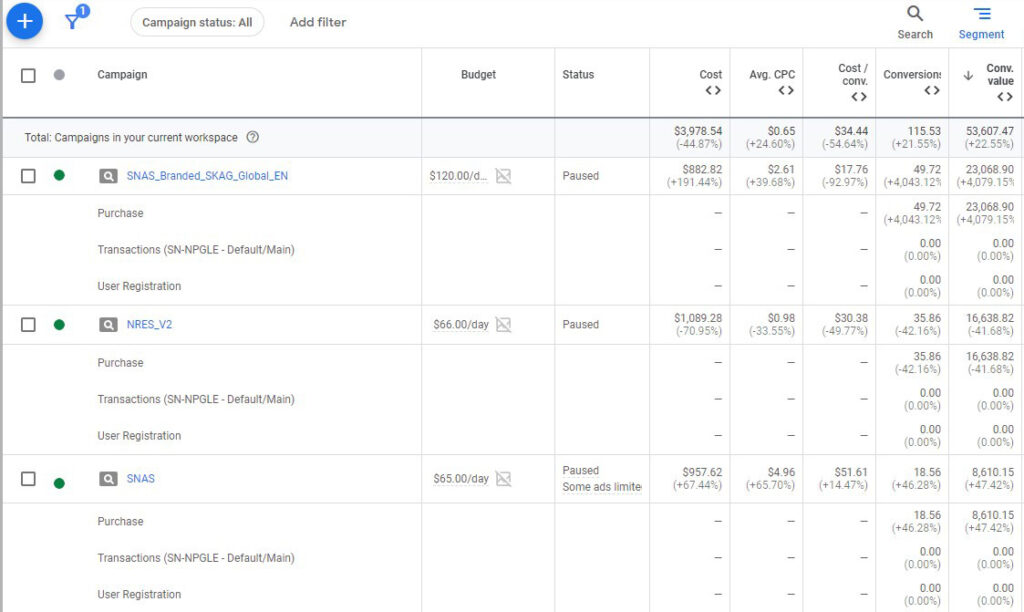
SNAS Keywords NovemberSNAS Search Terms November
Problem: Branded keywords are known to us; there are practically no reasons you'd want to use an automated bid strategy for a long tail keyword thatresults in sales.
Why Automated Bidding Fell Short
Keywords should be treated as intent categories, not literal phrases.
From Google’s perspective, “paper editing” is a semantic cousin of “Springer Nature Author Services”. Automated systems treat these as interchangeable signals, even though only one reliably converts.
Modern ad auctions are far more complex than they used to be.
In 2016:
Max CPC × Quality Score = Ad Rank
Today, Ad Rank incorporates bids, quality, relevance, signals, context, related auctions, and inferred intent.
Automated bidding systems attempt to optimize across all of these inputs simultaneously. The problem is not that they use signals, it’s that you have limited control over which signals they overweight.
A system may aggressively bid for top position, adding significant cost, then layer in marginal signals such as inferred interests or behavioral traits that have little bearing on actual purchase intent.
Costs rise quickly. Predictability disappears.
Where Automation Actually Works Well
Automation shines on short-tail, ambiguous keywords, especially at scale.
In one multilingual campaign, we managed a keyword that was an acronym, identical across languages but with completely different meanings. Manual bidding failed. Automated systems handled it elegantly by adapting to contextual signals.
The issue is not automation itself. The issue is where and how it’s applied.
We started with search term data, not keyword lists.
Using historical performance, we identified the exact queries responsible for conversions. These were overwhelmingly long-tail, high-intent phrases.
We selected search terms, not broad keyword categories, and promoted them into dedicated ad groups.
Step 2: Restructure Into SKAGs
Each high-performing term became its own Single Keyword Ad Group (SKAG).
This allowed:
Hyper-relevant ad copy
Exact headline-to-query matching
Improved Quality Score and Ad Rank
Lower, more predictable CPCs
We reused proven headlines and descriptions from historical data, then added dynamic keyword insertion to guarantee exact query alignment.
Nothing else changed. No landing page overhaul. No budget increase.
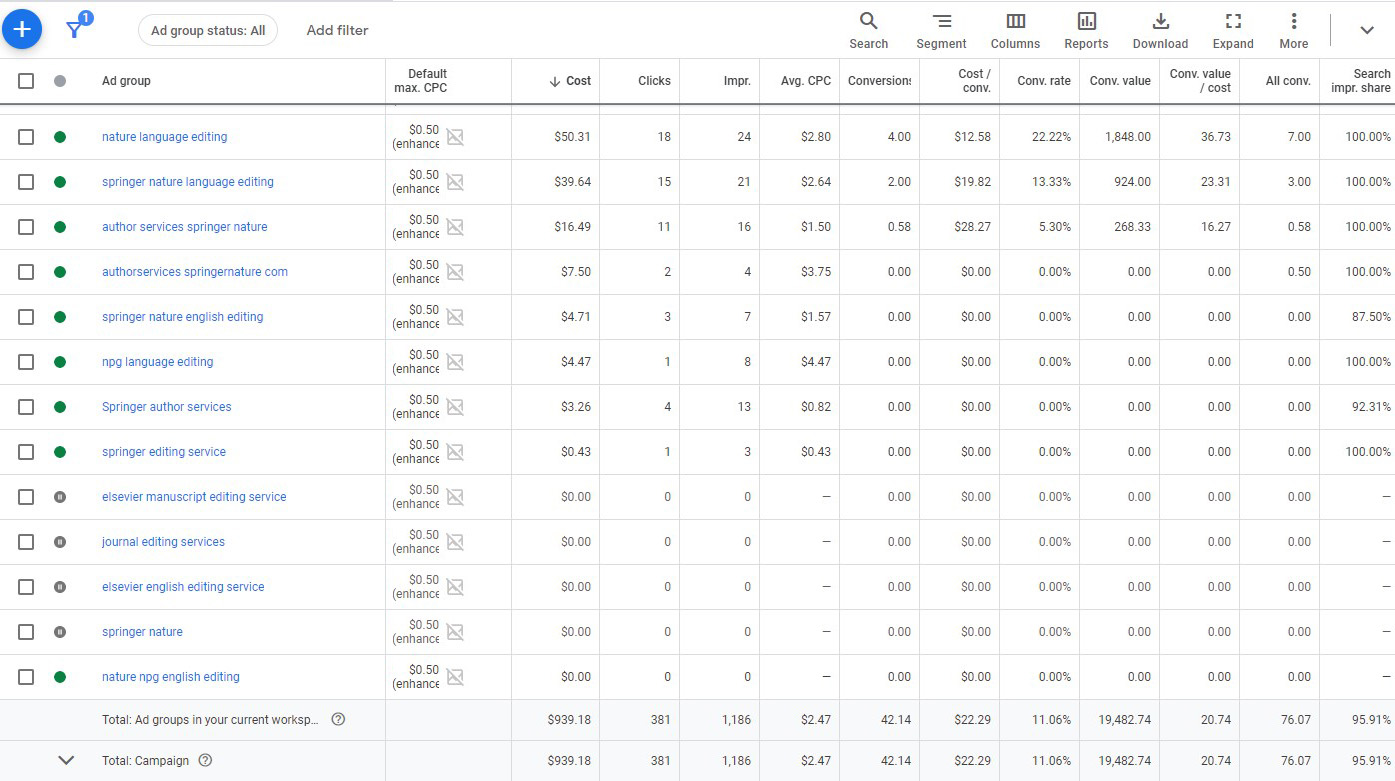
Automated Campaigns Vs SKAGs Cost Metrics
Why SKAGs Don’t Compete With Automation
We did not turn off automated campaigns.
Instead, we let SKAGs absorb known, high-intent traffic at lower cost. Because higher Quality Scores win auctions, the SKAGs naturally took precedence for converting terms.
Automated campaigns were left to do what they do best, expand coverage and explore new queries.
As SKAGs captured the profitable traffic, automated campaign spend dropped organically. In this account, automated spend fell by 70% within months.
The Result
More predictable costs
Higher Quality Scores
Cleaner attribution
Stable growth without wasted spend
By summer:
CPA down 59%
Conversion value up 39%
This wasn’t about fighting Google’s systems. It was about putting structure around them.
The Takeaway
Automation is a powerful tool.
Manual control is a necessary counterweight.
When you let machines explore and humans decide where precision matters, you get the best of both worlds.
That is how this account scaled more efficiently, without chasing vanity metrics or sacrificing control.
If you had told me a couple of years ago that I could type "a cyberpunk hedgehog making a latte" and get a photorealistic 4K video back in seconds, I would have laughed. But here we are in 2026, and AI video generation isn't just a novelty anymore, it's a massive part of my daily workflow.
This guide leverages my experience to break down how to write, structure, and publish a document that earns trust rather than just demanding attention.
Depending on who you ask, there are anywhere from five to twenty "essential" rules out there. But in my experience, there are really only a dozen “laws” of visual design that matter across every medium. Here’s a guide I’ve created with the elements I find to be the most important, no matter your platform.
I love WordPress for its customizations. Styling code snippets enhances user perceptions. Copy and paste the code below to style your WordPress code blocks.
If you had told me a couple of years ago that I could type "a cyberpunk hedgehog making a latte" and get a photorealistic 4K video back in seconds, I would have laughed. But here we are in 2026, and AI video generation isn't just a novelty anymore, it's a massive part of my daily workflow.
This guide leverages my experience to break down how to write, structure, and publish a document that earns trust rather than just demanding attention.
Depending on who you ask, there are anywhere from five to twenty "essential" rules out there. But in my experience, there are really only a dozen “laws” of visual design that matter across every medium. Here’s a guide I’ve created with the elements I find to be the most important, no matter your platform.
I love WordPress for its customizations. Styling code snippets enhances user perceptions. Copy and paste the code below to style your WordPress code blocks.