Learn how to measure UX design ROI using a practical framework based on real projects. Translate UX improvements into revenue with defensible metrics.
What Is the Value of a Good Web Design?
Good web design is not decoration. It is an economic input.
A poor user experience increases acquisition costs, suppresses conversion rates, and quietly erodes revenue across every channel. Research from PwC found that 32% of customers will abandon a brand after a single bad experience. That abandonment does not show up as a design problem, it shows up as higher cost per lead, lower close rates, and wasted media spend.
Design also has a direct impact on paid advertising efficiency. In pay-per-click advertising, the landing page experience is an AdRank factor that can directly impact your Google Adwords price per click. Two advertisers can bid the same amount and receive very different pricing based purely on user experience.
At the organizational level, the impact compounds. McKinsey’s Design Index showed that companies in the top quartile for design maturity significantly outperformed peers over time, achieving 32 percentage points higher revenue growth and 56 percentage points higher total returns to shareholders over a five-year period.
Top-quartile MDI scorers increased their revenues and total returns to shareholders (TRS) substantially faster than their industry counterparts did over a five-year period—32 percentage points higher revenue growth and 56 percentage points higher TRS growth for the period as a whole. - McKinsey
The pattern is consistent. Design does not simply improve usability. It improves the efficiency of every downstream business activity that depends on user behavior.
Table of Contents
How to Measure Web Design ROI
Return on investment can be expressed with a simple formula:
ROI = (Revenue Gain ÷ Cost of Investment) × 100
The difficulty with UX is not calculation, it is attribution.
Design improvements often continue to produce value long after a project ends. User journeys stretch across days or months. Behavioral changes compound quietly. Because of this, UX ROI must be measured within clearly defined constraints rather than trying to capture every future outcome.
Two principles make UX ROI measurable in practice:
1. Limit the Timeframe
Choose a reasonable measurement window, typically 6 to 12 months. You are not estimating the lifetime value of the design, only the value realized during an agreed period.
2. Convert Behavior Into Revenue
Not every outcome is a transaction, but most outcomes have an implied value. An email signup, a phone call, or a demo request can be assigned an average revenue value based on historical data.
For example, if one sale is generated for every four calls, and the average sale is worth $397, then each call is worth approximately $99. That relationship allows behavioral improvements to be translated into revenue impact.
Precision matters less than consistency. The goal is a defensible estimate, not a perfect one.
In a UX redesign project focused on landing pages, the primary changes were not visual flourishes. They were structural decisions, clearer messaging above the fold, simplified calls to action, and reduced friction in the conversion path.
National PPC traffic achieved a 26.06% average conversion rate
To measure uplift, performance before the redesign was compared to performance after launch, using the same traffic mix.
Uplift Formula
Uplift = (After − Before) ÷ After
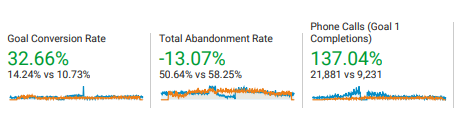
Calls, transactions, and conversion rate all showed the same uplift. That is expected, they are tightly correlated. Reporting all three would be redundant.
Revenue is the only metric required for ROI.
Revenue increased by $1,255,512 during the measurement period. Total labor cost for the project was $87,000.
ROI of Web Design
Before
After
Difference
%Uplift (After-Before/After)
Calls
9,231
21,881
12,650
137%
Conv. Rate
10.73%
14.24%
3.51%
32.66%
Transactions
2307
5470
3163
137%
Revenue
$915,879
$2,171,590
$1,255,512
137%
Final ROI
($1,255,512 ÷ $87,000) × 100 = 14,431%
Even when using a more conservative model that attributes only a portion of the uplift to UX changes, the ROI remains strongly positive.
Why Revenue Is the Only ROI Metric That Matters
Conversion rate alone is a weak proxy for business impact. Because sessions sit in the denominator, conversion rate can improve even as revenue stagnates or declines.
When leadership teams evaluate projects, they are choosing between competing uses of capital. They care about expected returns, not intermediate ratios.
If UX ROI cannot be expressed as a revenue-based number, it is not an investment case. It is a preference.
A Practical Takeaway
UX ROI is measurable when you apply constraints.
Define the timeframe. Translate behavior into revenue. Report outcomes in dollars.
Design becomes valuable not because it looks better, but because it removes friction from decisions that already matter.
When a board is determining whether or not to pursue your project, most boards want to know the costs and the expected returns before they approve it. The decision to move forward with your project is usually weighed against other revenue-driving initiatives.
There is no better way to measure returns than as a singular, revenue-based number.
How do you measure the ROI of UX design?
UX design ROI is measured by comparing revenue or revenue proxies before and after a design change within a fixed timeframe. Behavioral improvements such as increased conversions, calls, or signups are translated into revenue using historical averages, then divided by the total cost of the project.
What timeframe should be used to calculate UX ROI?
Most UX ROI analyses use a 6–12 month window. This limits attribution drift and provides a defensible comparison between baseline and post-launch performance without assuming long-term compounding effects.
Why isn’t conversion rate alone a good UX ROI metric?
Conversion rate does not account for traffic volume or revenue per conversion. It can improve even as total revenue declines. UX ROI should ultimately be expressed as a revenue-based figure to support business and investment decisions.
What if UX improvements can’t be directly tied to revenue?
When direct revenue attribution isn’t possible, UX outcomes should be converted into revenue proxies. For example, if historical data shows that one sale occurs for every four calls, each call can be assigned a proportional revenue value for ROI calculation.
If you had told me a couple of years ago that I could type "a cyberpunk hedgehog making a latte" and get a photorealistic 4K video back in seconds, I would have laughed. But here we are in 2026, and AI video generation isn't just a novelty anymore, it's a massive part of my daily workflow.
This guide leverages my experience to break down how to write, structure, and publish a document that earns trust rather than just demanding attention.
Depending on who you ask, there are anywhere from five to twenty "essential" rules out there. But in my experience, there are really only a dozen “laws” of visual design that matter across every medium. Here’s a guide I’ve created with the elements I find to be the most important, no matter your platform.
I love WordPress for its customizations. Styling code snippets enhances user perceptions. Copy and paste the code below to style your WordPress code blocks.
If you had told me a couple of years ago that I could type "a cyberpunk hedgehog making a latte" and get a photorealistic 4K video back in seconds, I would have laughed. But here we are in 2026, and AI video generation isn't just a novelty anymore, it's a massive part of my daily workflow.
This guide leverages my experience to break down how to write, structure, and publish a document that earns trust rather than just demanding attention.
Depending on who you ask, there are anywhere from five to twenty "essential" rules out there. But in my experience, there are really only a dozen “laws” of visual design that matter across every medium. Here’s a guide I’ve created with the elements I find to be the most important, no matter your platform.
I love WordPress for its customizations. Styling code snippets enhances user perceptions. Copy and paste the code below to style your WordPress code blocks.