How we cut cost per phone call by 94% using Google Ads restructuring, negative keywords, manual bidding, and conversion-focused landing pages.
The Problem: $284 Phone Calls From Non-Branded Search
We’ve worked inside Google Ads accounts with budgets as large as $40 million per quarter and as small as $10,000 per quarter. Across that entire range, the mechanics that determine success do not change. Structure, intent, and cost discipline matter more than spend.
That perspective matters here.
Before we took over this particular Google Ads account, six agencies had already rotated through it with no improvement to the bottom line. Activity was constant. Efficiency was nonexistent.
This was not a branded advertiser. There was no existing brand demand, no navigational searches, and no low-cost conversions from people already searching for the company by name. Every phone call had to be earned through competitive, non-branded search terms.
To put the issue in context, the industry average cost for a qualified phone call in this market was $60.93.
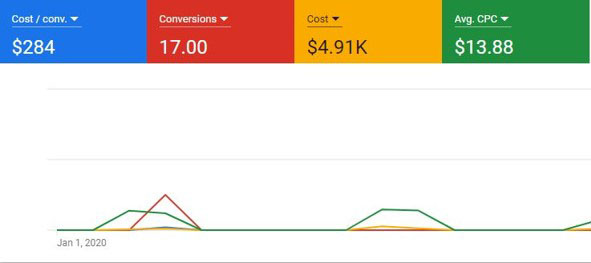
This account was paying $284 per call.
Nearly $5,000 in ad spend produced just 17 phone calls, many of which never turned into customers.
The account was misaligned, optimized for activity instead of intent, and overpaying for traffic that should have been controlled.
Table of Contents
What Changed After the Takeover
Once we assumed control, costs dropped quickly and predictably. Performance improved by correcting structural and intent mismatches inside the account.
Within months:
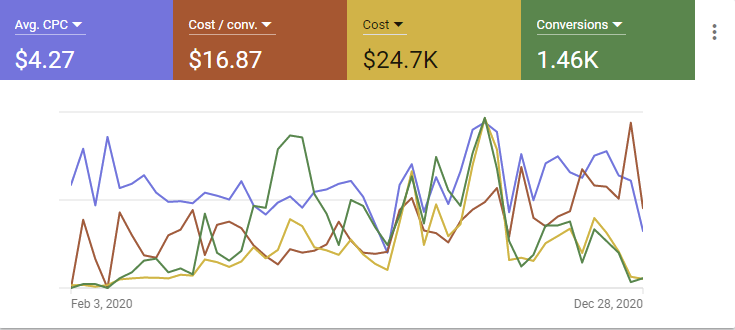
Average cost per call dropped to $16.87
Call quality improved
Call volume increased significantly
Nov - Feb
1. Campaign Restructuring Into SKAGs
We rebuilt the account using Single Keyword Ad Groups (SKAGs). This allowed precise control over:
Query matching
Ad copy relevance
Quality Score
Cost per click
Broad, mixed-intent ad groups were replaced with tightly scoped groups aligned to purchase-ready searches.
2. Negative Question Words
A major source of wasted spend came from question-based searches, phrases such as:
“prices for…”
“cheap…”
“how much does…”
These searches are exploratory by nature. They are not wrong queries, but they sit higher in the funnel and signal research, not readiness to transact.
For large organizations with content teams, nurture programs, and dedicated sales follow-up, this traffic can make sense. Most small businesses do not have that infrastructure.
Instead, we concentrated paid search spend on queries that signaled clear purchase intent, including:
“10 yard dumpster”
“dumpster for rent”
“30 yard dumpster Arkansas”
“roll off dumpster rental near me”
“same day dumpster rental”
Dumpster rentals behave more like a utility than a discretionary purchase. Demand already exists, and paid search performs best when it captures that demand rather than attempting to manufacture interest.
Paid search was used to funnel users who were mostly ready to buy, not to resolve every question upfront. Once a caller reaches the phone, the conversation naturally expands.
Callers still ask about:
Pricing and availability
Delivery timing
Permit requirements
Weight limits and overage fees
Those questions are expected. They belong in the sales conversation, not in the keyword list. Search ads determined who called. The phone conversation handled what they needed.
By excluding question-based keywords from paid search and redirecting that intent elsewhere, costs fell without sacrificing lead quality.
Google Ads Case Study Keyword Negatives List
3. Manual CPC for Cost Control
Automated bidding strategies optimize for actions, not outcomes. In this case, the system was optimizing for phone calls regardless of whether those calls resulted in sales.
That meant automations bid aggressively on:
Job seekers
Competitor lookups
Information-only queries
General curiosity
Manual bidding restored control. We bid based on known commercial intent, not probabilistic signals.
Automation still has a role, but not when cost discipline is the priority.
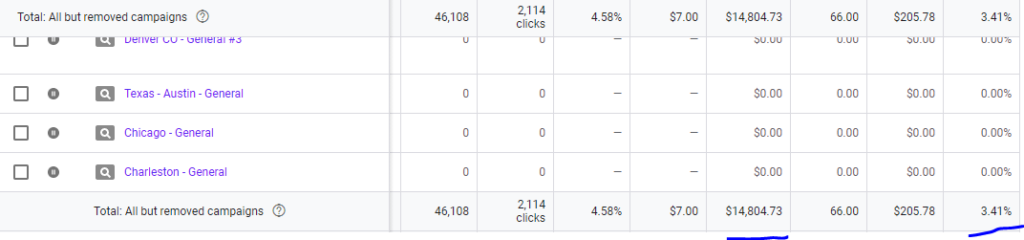
$400 Cost/Conv and 1.48% Conversion RateSitewide Conversion Rate Sep 2018 to Feb 2020 - 3.4% - $14,000 for 66 Phone Calls.
Why Negative Keywords Mattered So Much
Search queries signal where someone is in the decision process.
Someone searching “dumpster rental prices” is still comparing. Someone searching “dumpster rental Phoenix same day” is ready to order.
We focused spend on bottom-of-funnel intent and removed ambiguity from bidding decisions.
Lower intent queries weren’t discarded entirely, they became inputs for:
SEO content
Retargeting
Educational pages
Paid search stopped acting like a Q&A service and started acting like a sales channel.
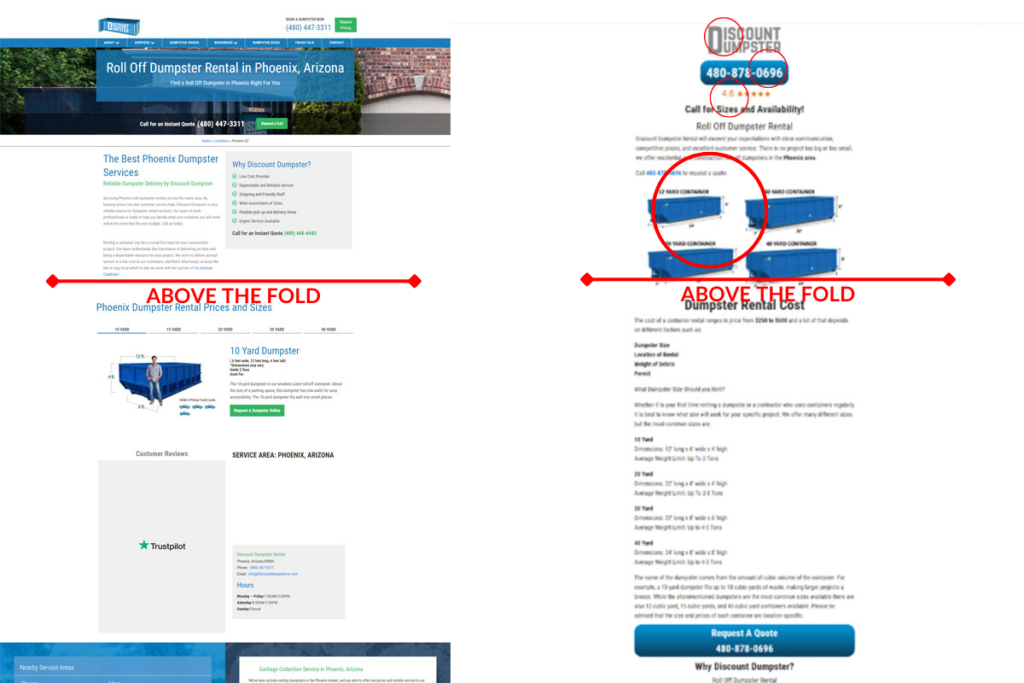
The original landing page was a generic location page designed for organic search. It converted at 1.48% for paid traffic and produced phone calls at nearly $400 each.
Website Redesign Case study above the fold before and after
Through A/B testing and iterative redesign:
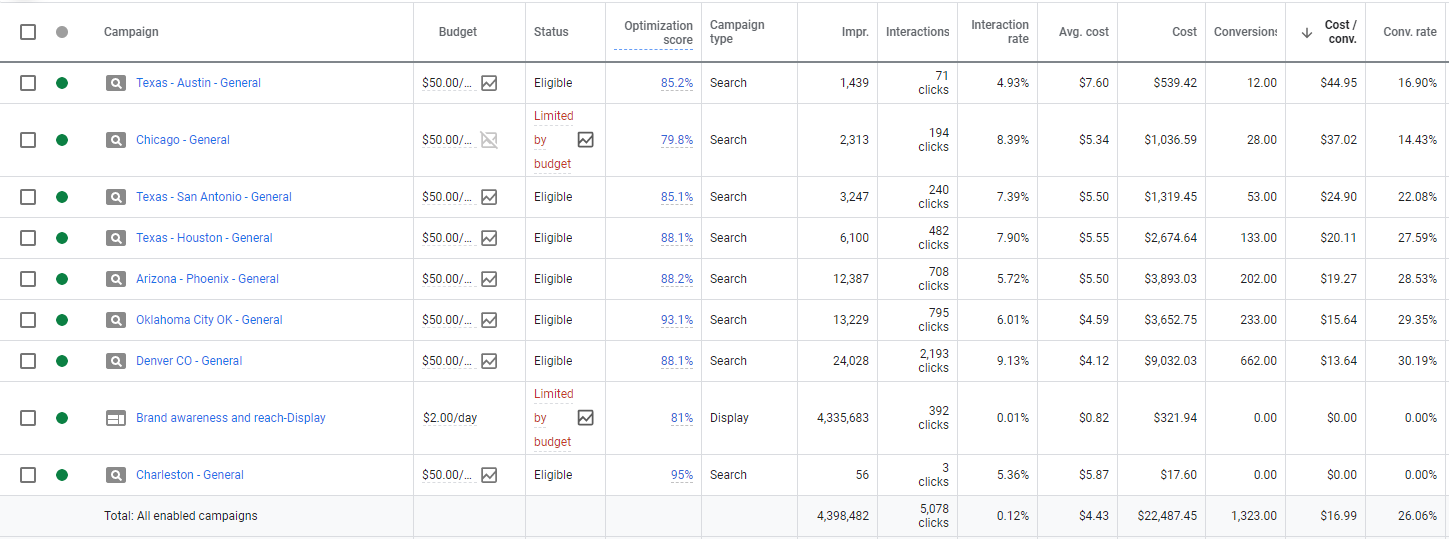
Conversion rate increased to 26%
Call quality improved
Waste declined further
Above-the-fold changes mattered most:
No navigation menu
Clear product imagery
Trust signals and reviews
Immediate call clarity
This wasn’t cosmetic design. It was intent alignment.
Google Ads Case Study 26.06% Conversion Rate
End-to-End Attribution Confirmed the Outcome
Using CallRail and Salesforce, we tracked calls through to actual sales.
Bottom-of-funnel callers converted at a much higher rate than exploratory callers. The data confirmed what intuition already suggested, people who are ready to buy do not need convincing.
Final Outcome
Over roughly one year and $24,000 in ad spend, the account stabilized at a profitable $16.87 per qualified phone call, with more volume and better customers than before.
Adwords Yearly Review
The Numbers (Before vs After)
Cost Per Conversion
$284 → $16.87
94.1% reduction
Cost Per Click
$13.88 → $4.27
68.1% reduction (3.13× efficiency)
Conversion Rate
3.41% → 26.06%
764% improvement (7.64× lift)
Net Effect
3.13 × 7.64 = 23.9× more leads with the same budget
This wasn’t growth through spend. It was growth through structure.
This wasn’t about clever tactics.
It was about discipline.
The Takeaway
When you align:
Search intent
Bidding control
Landing page relevance
Costs fall, conversion rates rise, and growth becomes predictable.
That’s how this account achieved 23.9× more leads with the same budget, without chasing volume or relying on guesswork.
If you had told me a couple of years ago that I could type "a cyberpunk hedgehog making a latte" and get a photorealistic 4K video back in seconds, I would have laughed. But here we are in 2026, and AI video generation isn't just a novelty anymore, it's a massive part of my daily workflow.
This guide leverages my experience to break down how to write, structure, and publish a document that earns trust rather than just demanding attention.
Depending on who you ask, there are anywhere from five to twenty "essential" rules out there. But in my experience, there are really only a dozen “laws” of visual design that matter across every medium. Here’s a guide I’ve created with the elements I find to be the most important, no matter your platform.
I love WordPress for its customizations. Styling code snippets enhances user perceptions. Copy and paste the code below to style your WordPress code blocks.
If you had told me a couple of years ago that I could type "a cyberpunk hedgehog making a latte" and get a photorealistic 4K video back in seconds, I would have laughed. But here we are in 2026, and AI video generation isn't just a novelty anymore, it's a massive part of my daily workflow.
This guide leverages my experience to break down how to write, structure, and publish a document that earns trust rather than just demanding attention.
Depending on who you ask, there are anywhere from five to twenty "essential" rules out there. But in my experience, there are really only a dozen “laws” of visual design that matter across every medium. Here’s a guide I’ve created with the elements I find to be the most important, no matter your platform.
I love WordPress for its customizations. Styling code snippets enhances user perceptions. Copy and paste the code below to style your WordPress code blocks.