This guide leverages my experience to break down how to write, structure, and publish a document that earns trust rather than just demanding attention.
I’ve helped B2B organizations bridge the gap between tech and design throughout the years, and I’ve found that the most misunderstood and often under-utilized assets are white papers. As I’ve recently taken on a role with Lubble, and while authoring some papers, I’ve been thinking about what makes a great white paper stand out and what is the actual value of them?
The answer is clarity. A well-crafted white paper cuts through the noise of standard marketing to offer genuine utility. It’s a valuable tool that you are sharing with your client or potential client. By sharing your expertise, you are in turn gaining the trust of your reader. A white paper is a chance to showcase your knowledge, and a great place to develop authority in your subject virtually.
At its core, a white paper is an authoritative, in-depth report on a specific topic that presents a problem and provides a solution. It is characterized by a formal tone, rigorous evidence, and an expert perspective. Unlike a blog post, which is often opinion-based, or a sales brochure, which focuses on product features, a white paper is an educational tool used to guide a reader through a complex methodology and equip them with the knowledge needed in order to make important decisions.
From Policy to B2B
The concept of White Papers originated in government sectors. The term comes from the British government's usage in the early 20th century, a notable example of which is the Churchill White Paper of 1922. During that era, White Papers became the standard method to present policy preferences before legislation was introduced. They were designed to clearly inform decision makers through structured problem–solution analysis. Today, the format has evolved into a staple for B2B technology, consulting, and regulated industries.
White Paper Audience Types
The first mistake many writers make is confusing their audience with their user base. White papers are rarely read by the end-user of a product, but they are often scrutinized by the stakeholders. Because of this, your underlying purpose of the paper should not be to train a user, but rather to reassure a buyer.
Government & NGO: These readers look for policy alignment, long-term stability, and societal impact.
Enterprise B2B: These readers look for risk mitigation, Return on Investment (ROI), and integration feasibility.
The Purpose of a White Paper
The goal of the document is to inform decision-making over long evaluation cycles. In high-stakes B2B sales, the buying cycle can last 6 to 18 months. A white paper acts as your proxy in the room when you aren't there, explaining complex problems and validating your solution against the status quo.
Tone: Authority Through Clarity
To succeed, the tone of your paper must be objective, informative, and accessible.
Do: Use data, cite sources, and acknowledge counter-arguments.
Don't: Use hyperbolic language or sales copy.
Rule of Thumb: If it sounds like a pitch, you lose the reader's trust. You gain authority by explaining the problem better than they can explain it themselves.
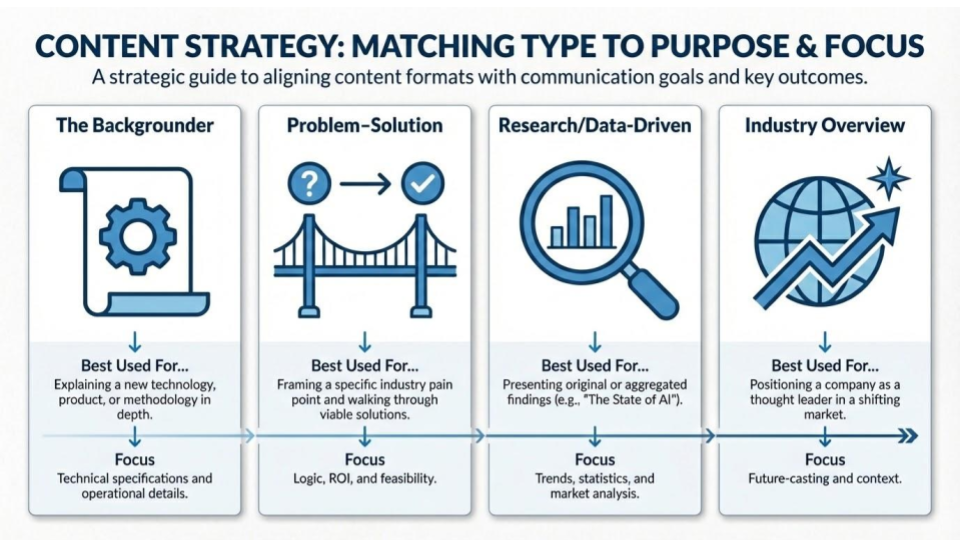
Types of White Papers (and When to Use Each)
There are different White Papers for different uses. Choosing the right format is critical.
Type
Best Used For...
Focus
The Backgrounder
Explaining a new technology, product, or methodology in depth.
Technical specifications and operational details.
Problem–Solution
Framing a specific industry pain point and walking through viable solutions.
Logic, ROI, and feasibility.
Research/Data-Driven
Presenting original or aggregated findings (e.g., "The State of AI").
Trends, statistics, and market analysis.
Industry Overview
Positioning a company as a thought leader in a shifting market.
Future-casting and context.
The Core Structure of a White Paper
A White Paper follows the scientific method more closely than a marketing funnel. It adheres to a Problem–Solution model. Here’s a list of the common components that build a successful White Paper:
Common Components
Executive Summary: A concise overview of the document.
Introduction/Background: Establishing the context and urgency of the topic.
Problem Description: Defining the core challenge and its underlying causes.
Solution(s): A detailed analysis of viable approaches to address the problem.
Recommendations: Strategic advice on the best course of action based on the evidence.
Conclusion: Reinforcing the main point and value proposition.
References: The evidence that validates claims and ensures credibility.
Note on Titles: Avoid generic headers. Instead of "Problem," use "The Latency Challenge in Modern Data Stacks." Specificity signals expertise.
At a glance:
Phase
Section
Purpose
The Hook
Executive Summary
Immediate Value
The Context
Introduction
Urgency & Scope
The Conflict
Problem Description
Pain Point Validation
The Resolution
Solution
Technical Path
The Action
Recommendation
Strategic Roadmap
The Reinforcer
Conclusion
Reinstates Value
The Evidence
References
Ensure Credibility
Though the common components can be found in most White Papers, the manner in which they are used varies depending on the complexity and type of paper you are authoring.
Here’s some examples of stellar White Papers organized by complexity. By viewing these, you can identify the differences of how they utilize each component, and the depth in which they go into them depending on the paper’s goal.
Why it works: This is a classic Backgrounder paper. The reader already knows they need cloud security; they just need to know if Google's specific infrastructure is safe.
Structure: It doesn't waste time on "Why Security Matters." It jumps straight into technical specifications like hardware design, secure boot stacks, and data disposal.
Goal: Technical validation. It proves the tool works as promised.
Why it works: This Industry Overview paper is an example of introducing a larger organizational philosophy shift. It’s written to address leaders considering a pivot in their larger business strategies.
Structure: Shows context, introduces a systematic problem, then produces a strategic roadmap (Four Pillars) for long-term changes.
Goal: Executive Alignment. It’s designed to change how the C-Suite thinks about their entire business model.
Writing Each Section
Executive Summary
Although this appears first, write it last. This is the most critical section for busy individuals that may only glance at the document. It must summarize the problem, the solution, and the final recommendation in under one page. If an executive reads nothing else, they should still walk away understanding your value proposition.
Introduction and Background
Provide context without overwhelming the reader. Establish why this topic matters right now. Has there been a regulatory change? A shift in technology? Set up the problem objectively.
Describing the Problem
This is where you win or lose the reader. You must define the core problem, identify its causes, and explain the consequences of inaction.
Be Specific: Relate directly to the reader’s specific pain points.
Use Evidence: Back every claim with a citation.
Structure: If the problem is complex, break it down into sub-sections.
Presenting Solutions
Once you have defined the problem, you must navigate the transition to the solution without pivoting into a sales pitch.
Detailing the Approach: Break the solution down into its mechanical or strategic parts. If you are proposing a new software architecture, illustrate the data flow. If it’s a management methodology, outline the operational phases.
Logical Alignment: Every feature of your solution must map back to a pain point identified in the previous section. If you didn't mention a problem earlier, don't introduce a solution for it now.
Acknowledge Alternatives: A truly authoritative paper acknowledges that there are multiple solutions to any problem. Briefly discuss the strengths and weaknesses of the status quo or competing methodologies.
The "Neutral" Edge: By being honest about where a solution might not fit, you gain immense credibility for the areas where you claim it is a perfect match.
Recommendations (If Applicable)
Recommendations are the bridge between theory and real world options. It’s important to make sure your recommendations are best for the reader, not a sales pitch.
Strategic vs. Tactical: Focus on high-level strategic advice.
Evidence-Based: Every recommendation should feel like the natural, inevitable conclusion of the data you presented earlier.
How to Conclude a White Paper
The conclusion is your final opportunity to leave a lasting impression. It should not introduce new information.
Reinforce the Stakes: Briefly remind the reader of the cost of inaction.
Summarize Insights: Reiterate the 2–3 key moments from the paper.
The Informed Finish: Unlike a landing page, the call to action (CTA) here should be soft.
Research and Evidence Standards
A white paper is only as strong as its weakest source.
Original vs. Aggregated: Original research is like surveys or lab results, and a valuable asset due to its exclusivity. Aggregated research sites authoritative sources are excellent for providing context and showing your dedication to obtaining the most authoritative sources.
Expert Interviews: Quote your internal Subject Matter Experts (SMEs). This humanizes the data and anchors the authority within your organization.
Citations: Use a consistent citation style (like APA or Chicago). Links should be unobtrusive but verifiable.
Writing Style and Clarity
The Jargon Filter: If a phrase only makes sense to your engineering team, translate it for the C-Suite.
Signposting: Use indicator language. Phrases like "In the next section, we will examine..." help the reader build a mental map of the topic.
Decision-Makers vs. Algorithms: Write for the human who has to sign the check. SEO matters for discovery, but trust is what closes the deal.
Common White Paper Mistakes to Avoid
The "Bait and Switch": Promoting a "Research Report" that is actually a 10-page brochure for your software will destroy your brand trust instantly.
Data Vomit: Including charts and graphs without explaining what they mean for the reader’s business.
Weak Framing: If the problem you’re solving feels trivial, the solution your presenting will feel expensive.
Ignoring Design: A wall of 10pt Times New Roman text will go unread, regardless of how brilliant the content is.
Format and Design Considerations
Visual Aids: Use diagrams to explain complex workflows. A single well-designed chart can replace 500 words of dense technical prose.
Readability: Use ample white space, sub-headers about every 300 words, and bolded quotes for key takeaways.
Accessibility: Ensure your PDF is tagged for screen readers and that your color contrast is high enough for all readers.
The "Gate" is the form a user fills out to download the paper.
To Gate: Use this if the paper is a High Value asset intended for lead generation.
Not to Gate: Use this if your goal is maximum reach, brand awareness, or establishing a new category.
The Hybrid: Provide the Executive Summary and Introduction as an open web page, then gate the full technical document.
Measuring Success and Iteration
Don't just track downloads. Track influence. Ask yourself these questions:
Sales Enablement: Are your sales reps actually sending this to prospects?
Backlinks: Is the industry citing your data?
Longevity: A great white paper should have a shelf life of 12–24 months. If the data becomes stale, issue a Version 2.0 rather than starting from scratch.
Final Thoughts
A white paper is an act of generosity. You are giving away your hard-earned expertise in exchange for the reader’s most valuable commodity, their time. By adhering to a proven structure and prioritizing clarity, you don't just find potential customers, you also build a reputation for your expertise.
If you had told me a couple of years ago that I could type "a cyberpunk hedgehog making a latte" and get a photorealistic 4K video back in seconds, I would have laughed. But here we are in 2026, and AI video generation isn't just a novelty anymore, it's a massive part of my daily workflow.
This guide leverages my experience to break down how to write, structure, and publish a document that earns trust rather than just demanding attention.
Depending on who you ask, there are anywhere from five to twenty "essential" rules out there. But in my experience, there are really only a dozen “laws” of visual design that matter across every medium. Here’s a guide I’ve created with the elements I find to be the most important, no matter your platform.
I love WordPress for its customizations. Styling code snippets enhances user perceptions. Copy and paste the code below to style your WordPress code blocks.
If you had told me a couple of years ago that I could type "a cyberpunk hedgehog making a latte" and get a photorealistic 4K video back in seconds, I would have laughed. But here we are in 2026, and AI video generation isn't just a novelty anymore, it's a massive part of my daily workflow.
This guide leverages my experience to break down how to write, structure, and publish a document that earns trust rather than just demanding attention.
Depending on who you ask, there are anywhere from five to twenty "essential" rules out there. But in my experience, there are really only a dozen “laws” of visual design that matter across every medium. Here’s a guide I’ve created with the elements I find to be the most important, no matter your platform.
I love WordPress for its customizations. Styling code snippets enhances user perceptions. Copy and paste the code below to style your WordPress code blocks.